
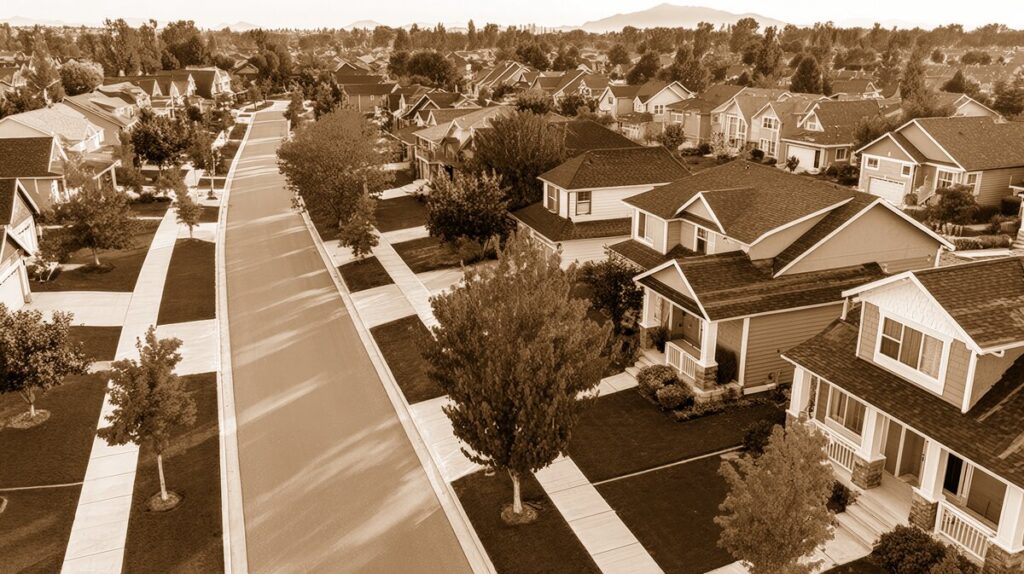
A Neighborhood with a Regional Identity
Ask longtime residents where The Hills South is located, and you may hear several answers: Englewood, Cherry Creek Vista, southeast Denver, or simply “near the reservoir.” All are understandable. The neighborhood carries an Englewood mailing address, lies within the broader Cherry Creek Vista area, and is closely connected to the parks, schools, business centers, and open spaces of the southeast metro region.
The Hills South is not a historic district in the same way as older Denver neighborhoods such as Capitol Hill or Washington Park. Its heritage is newer, shaped largely in the 1970s and 1980s as open land along the Cherry Creek corridor became part of a carefully planned suburban community. Yet its story reaches back much farther—to the gold rush, early ranching, rural roads, and the gradual transformation of Arapahoe County into one of Colorado’s most active residential regions.
Before the Neighborhood: Creek, Prairie, and Gold
The land around present-day The Hills South was once part of a broad prairie landscape crossed by Cherry Creek and smaller tributaries. Long before homes lined streets such as East Crestline Avenue, South Havana Street, East Berry Place, and South Joliet Way, the area was open country used for agriculture, grazing, and travel.
The wider Englewood story began in 1858, when prospectors discovered gold near the mouth of Little Dry Creek, close to what is now Dartmouth Avenue. That discovery helped ignite the Colorado Gold Rush and brought settlers, merchants, and transportation routes into the South Platte and Cherry Creek valleys. Englewood was formally incorporated in 1903, but much of the surrounding countryside remained rural for decades afterward. ([englewoodgov.civicweb.net](https://englewoodgov.civicweb.net/document/426371/306FBAA11DD14FDD85828B77C0A3D957-.pdf?handle=9FEFAE2321344768B8E6C32455880005&utm_source=openai))
The neighborhood’s location also reflects the importance of water. Cherry Creek was not merely a name chosen by a developer; it was a real geographic feature that influenced settlement, transportation, farming, and later recreation. Today, the creek and reservoir landscape remain central to the area’s identity.
How The Hills South Got Its Name
The name “The Hills South” is best understood as part of the naming language used for the larger Cherry Creek Vista development. The community was laid out in several sections and filings, including The Hills at Cherry Creek and later areas identified as The Hills South. The name evokes the gently rolling terrain east and south of the Cherry Creek corridor, while also distinguishing the neighborhood from neighboring residential sections such as The Hills West and other Cherry Creek Vista subdivisions.
Unlike some Denver neighborhoods whose names honor a person or a specific historic event, The Hills South appears to have received its name as a planned-community designation. Its identity grew from subdivision maps, homeowners’ associations, park districts, and the larger marketing vision of an executive-style residential setting close to the Denver Technological Center and Cherry Creek Reservoir.
That does not make the name insignificant. In Colorado, “the hills” has long suggested a transition zone between flat prairie and mountain foothills. Here, the phrase captures both the neighborhood’s modestly rolling topography and its position on the edge of a rapidly urbanizing landscape.
Development in the 1970s and 1980s
The Hills at Cherry Creek began taking shape during a major period of south-metro growth. After World War II, Denver expanded steadily toward Arapahoe County. New highways, office parks, schools, shopping centers, and suburban subdivisions followed. The construction of Interstate 25 and the rise of the Denver Tech Center made southeast metro Denver especially attractive to professionals seeking larger homes near employment centers.
Property records show that many homes in The Hills at Cherry Creek date from the mid-1970s through the 1980s. Examples include homes built in 1975, 1978, 1979, and 1982, reflecting the neighborhood’s primary development era. ([realtor.com](https://www.realtor.com/realestateandhomes-detail/5220-S-Joliet-Way_Englewood_CO_80111_M26852-62407?utm_source=openai))
The architecture is characteristic of that period: spacious two-story houses, traditional brick exteriors, wood and stucco accents, vaulted interiors, generous garages, and landscaped lots. Some homes were built for families who wanted room to grow, while others were custom-designed with distinctive fireplaces, walk-out basements, mature evergreens, and views toward the surrounding open space.
The street plan helped create a sense of privacy. Cul-de-sacs and curving residential roads soften the suburban grid, while streets such as East Crestline Avenue, East Berry Place, South Havana Court, and South Joliet Way connect residents to larger routes without carrying heavy through traffic.
Parks, Recreation, and Community Life
One of the neighborhood’s most important historical features is its connection to shared recreation. The Hills at Cherry Creek helped establish a special district to support community amenities, including parks, tennis facilities, basketball courts, and boundary improvements. Those features gave the neighborhood more than private yards; they created places where generations of residents could meet, play, and recognize one another. ([compass.com](https://www.compass.com/homedetails/10955-E-Crestline-Pl-Englewood-CO-80111/120TU8_pid/?utm_source=openai))
The broader Cherry Creek Vista area is also associated with a park and recreation district that maintains multiple parks, playgrounds, courts, a pool, a community room, and related public spaces. ([kennarealestate.com](https://kennarealestate.com/englewood/cherry-creek-vista/area-guide?utm_source=openai))
Nearby Cherry Creek State Park is the area’s signature landmark. The reservoir, trails, open grasslands, boat areas, and wildlife habitat offer a remarkable contrast to the neighborhood’s carefully landscaped streets. For many residents, a walk or bike ride toward the reservoir is part of the everyday rhythm of living here. The park also preserves a sense of the region’s earlier openness, even as office buildings and residential development continue to fill the surrounding landscape.
Schools and Institutions
Education has been another important part of The Hills South’s heritage. The neighborhood is associated with the Cherry Creek School District, one of the area’s defining institutions. The district’s history reaches back to the original Cherry Creek Schoolhouse, built in 1874 and recognized as the oldest surviving school in the district. ([en.wikipedia.org](https://en.wikipedia.org/wiki/Cherry_Creek_School_District?utm_source=openai))
Although The Hills South itself was developed nearly a century later, families moving into the neighborhood became part of that longer educational tradition. Local schools, youth sports, recreation programs, and community gatherings helped turn what was once open land into a settled neighborhood with its own daily customs.
The nearby Denver Tech Center also played a major role in the community’s evolution. As office towers, hotels, restaurants, and corporate campuses expanded along the I-25 corridor, The Hills South became a convenient residential base for employees and families connected to the region’s growing business economy.
A Neighborhood That Has Matured
Over the decades, The Hills South has changed in ways that are easy to notice but gentle enough to preserve its original character. Young trees have become mature shade and evergreen canopies. Original homeowners have been joined by second- and third-generation residents. Some houses have been remodeled extensively, while others retain their late-1970s or early-1980s details.
The neighborhood’s greatest transformation may be its relationship to the surrounding community. What was once a distant suburban edge is now close to major employment centers, retail districts, medical services, trails, and regional recreation. Yet the interior streets remain calm and residential.
That balance is what longtime residents often treasure most. The Hills South offers the convenience of metropolitan life without giving up the feeling of a tucked-away community. Its heritage is found not in one famous building, but in the accumulated character of its streets, parks, schools, homes, and shared routines.
The Spirit of The Hills South Today
The Hills South is a neighborhood shaped by transition: prairie becoming suburb, farmland giving way to planned development, and a once-remote corner of Arapahoe County becoming part of the busy Cherry Creek region.
Its history is still relatively young, but it is already layered. The gold-seeking travelers of the 1850s, the rural landowners of the early twentieth century, the builders of the 1970s, and the families living here today all belong to the same continuing story.
Walk along the quiet streets near East Crestline or South Havana, visit a neighborhood park, or follow the trails toward Cherry Creek State Park, and the appeal becomes clear. The Hills South is special because it feels established without feeling frozen—a place where the landscape, the homes, and the people have had time to grow together.